

MINAL Bathwal has quietly become one of the world’s most successful macro hedge fund managers, making billions of dollars at Brevan Howard Asset Management.
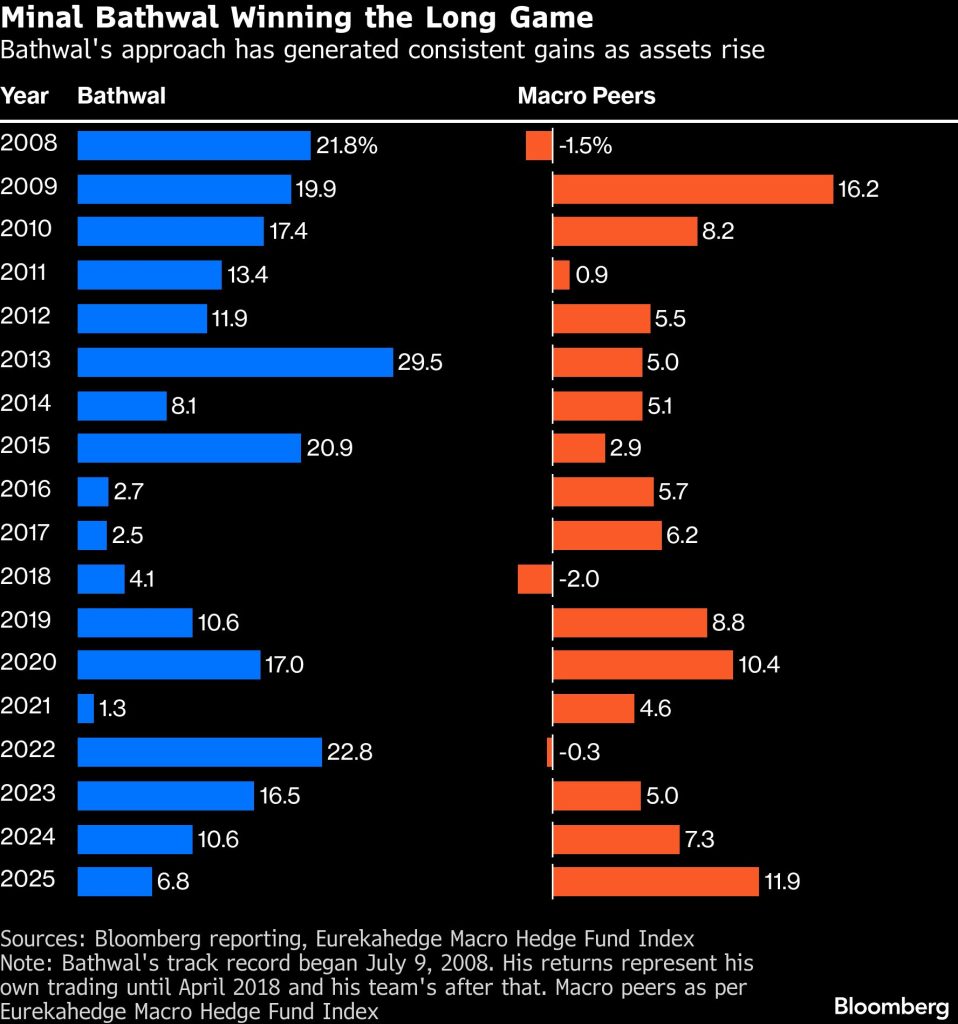
Bathwal hasn’t had a single down year since he started managing money during the 2008 financial crisis — making him a standout in the global macro style of investing that has recently surged in popularity. Now running around $5.5 billion, the Singapore-based fund manager has scored wins on everything from the trajectory of Korean interest rates to the swings of Asian currencies.
This winning run has secured him a place among the five biggest generators of investment profits in the history of Brevan Howard, a $35 billion hedge fund giant that was founded more than two decades ago. He ranks only behind the likes of Alan Howard, the eponymous co-founder who no longer actively trades, and Chris Rokos, another co-founder who brought in around $4 billion before leaving to set up his own firm, court filings show.
But despite securing his legend at one of the world’s biggest hedge fund firms, and becoming a coveted client for global banks, the 44-year-old Bathwal remains a relative unknown to outsiders.
While Bridgewater founder Ray Dalio has written numerous books espousing his view of the world, and titans like Bill Ackman and Cliff Asness regularly use social media to talk about markets, Bathwal remains extremely private. He shuns public appearances and has just seven LinkedIn connections. He keeps such a low profile that an old colleague jokes he wouldn’t recognize him in the street.
Global macro funds are booming, returning to favor among investors looking to profit from wild swings in everything from Japanese government debt to the price of gold. Investors responding to a recent BNP Paribas SA survey predicted discretionary macro will be the top performing hedge fund strategy this year. They added a lament: There aren’t enough funds led by a single chief with a long track record.
Bathwal appears to fit the bill. A majority of the money in the strategy he leads comes from various other Brevan Howard funds, and another chunk represents retained profits. The strategy has briefly opened a handful of times since it began trading in May 2018, giving a select few external investors a chance to get in alongside other Brevan Howard funds. Some investors wait years for the chance.
Bathwal’s time at Brevan Howard isn’t a story of unchecked success: His returns of around 6.8% last year paled in comparison to some of his biggest rivals, who generated double-digit profits as shifting expectations of the Federal Reserve’s rate path and fears of de-dollarization created a rich environment for macro specialists.
But his long-term track record and consistency are hard to dispute, fueling comparisons with legends such as Stanley Druckenmiller and former colleague Rokos — macro titans who put together decades of returns.
“Minal’s long-term track record and consistency at scale have helped put Asia macro on the map as a major-league opportunity,” said Michael Garrow, chief investment officer of Hong Kong-based HS Group, who has met the fund manager multiple times. “If you look at people that have made returns at a very large scale for a long time, you see several parallels to Minal, with his calmly objective demeanor and ability to stay disciplined through short-term noise.”
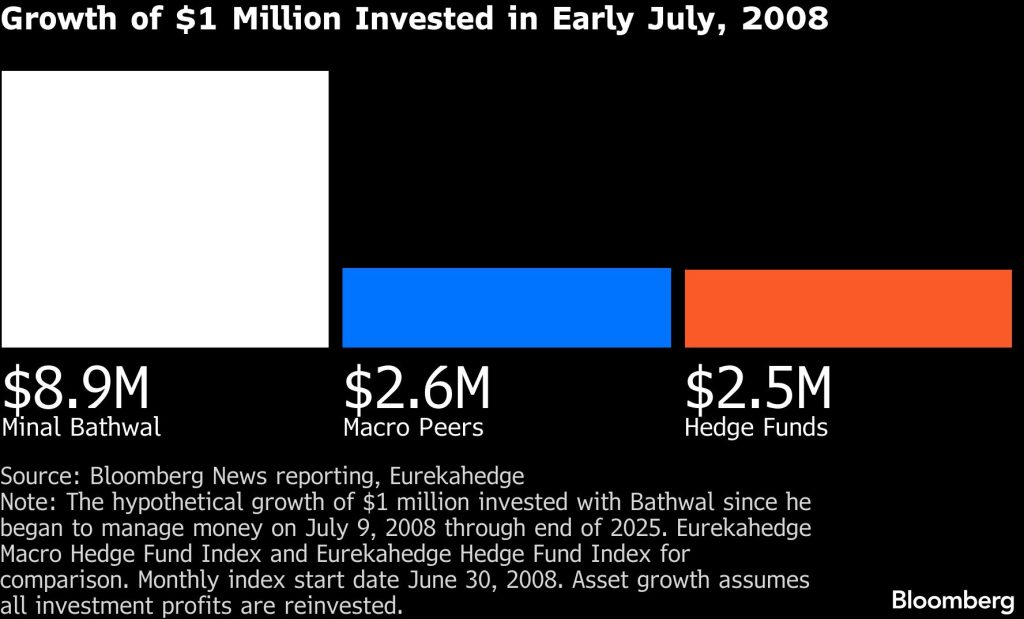
Bathwal and his team have generated an annualized return of 12.7% between 2008 and the end of 2025. His trading gains have been achieved with a Sharpe ratio — a measure of a fund’s returns against its level of risk — of 1.7. By comparison, discretionary macro hedge funds have had a Sharpe ratio of 1.4 since 2008, according to data compiled by research firm PivotalPath.
This story about Bathwal and his investment style is based on conversations with more than 10 people who have either worked with or met him, almost all of whom spoke on condition of anonymity.
A representative for the firm and Bathwal declined to comment.
Rapid Rise
Bathwal got his first taste of managing money in the summer of 2008.
The US subprime mortgage crisis was sending shock waves throughout markets. Global stocks were in free fall. Asian currencies, including those of South Korea, India and Malaysia, were cratering against the dollar. The Fed was in the middle of a historic series of interest-rate cuts that unleashed more than a decade of easy money.
Bathwal had joined a year earlier as a junior trader in Brevan Howard’s Hong Kong office, and at that point had no real experience of investing. What he did have was a deep knowledge of how to assemble complicated trades, thanks to his previous job as a structurer at UBS Group AG.
Whether they’re working for companies trying to hedge currency risk or retail investors looking to juice up returns, structurers tailor and price products — ideally with asymmetric payoffs. This knowledge of derivatives and the understanding of global markets and trading skills he was developing at Brevan Howard provided a foundation for Bathwal in those first few weeks and months of managing money.
His early wins included a series of bets over about two years on both the direction and volatility of South Korean rates. It was the largest emerging Asia rates market and the one he dabbled in the most in his UBS days.
The country’s central bank surprised the market with record rate cuts starting from 2008, trying to soften the blow of the global financial crisis. His returns almost immediately got attention from his bosses, who allocated him more capital out of the firm’s Master Fund to manage within months.
He finished the year up 21.81% over six months of trading. In late 2010, he started trading for the firm’s Asia fund, eventually becoming its co-CIO in 2016.
Bathwal, who got his MBA from the Indian Institute of Management Calcutta, said in an interview on Brevan Howard’s internal website that his lack of prior trading experience turned out to be “immensely helpful.”
“Having a blank canvas helped me shape my style and evolve over time,” he said.
Since then, he has generated billions. He scored a 29.49% gain in 2013, as Japan’s ‘Abenomics’ experiment sent the yen tumbling against the dollar and the so-called taper tantrum roiled emerging-market assets. He chalked up a 20.9% return in 2015, making money from movements in various Asian currencies after the greenback strengthened from the second half of 2014, including the yuan devaluation. In March 2020, as the spread of the Covid-19 pandemic triggered a sell-off across markets, his fund gained 5.46%.
Last year, he is said to have won from trades related to shifting expectations of Fed rate decisions.
Although he manages a majority of the capital in the fund himself, Bathwal has built a 14-strong investment team, including 10 traders. Among them are six junior portfolio managers who trade their own books within the fund: Manu Kapoor, Ankit Soni, Abhishek Pal, Rishi Singh, Swapnil Kalbande and Stephen Wang.
People who know Bathwal describe him as philosophical. He is willing to adjust the size of positions without emotion when the markets move against him, while avoiding costly over-trading, a trap that some industry peers fall into.
That isn’t all instinct. Bathwal is a fan of the work of behavioral economist Daniel Kahneman, who has studied the biases that get in the way of making good decisions and acknowledging bad ones.
In the internal interview, Bathwal said the “first true test” of being a good trader is your spouse or partner not being able to tell whether you had a good day or a bad day when you get home from work. “Be passionate about work, not emotional,” he said.
Trading Style
There are a few broad strokes that describe Bathwal’s trading style: He attempts to create option-like payoffs, where relatively small costs can yield much bigger returns. Extraordinary care is given to identifying the best financial instruments to express his views, hedges and the sequencing of different legs of trades, said people familiar with his approach.
He uses a mix of short-term and medium-term trades and sometimes puts on multiple wagers around the same theme, aware of the connections between markets, the people said. Although allocations fluctuate over time, a third of the strategy’s investments may be in ideas unrelated to Asia. Bathwal has long been keen to invest in other regions, and the growing assets at his disposal have given him more firepower to do so, one of them said.
Bathwal’s trading approach falls in line with the trademark Brevan Howard style and was learned from Kaspar Ernst, who hired him when running Brevan Howard’s Asia business in 2007. Like Ernst, Bathwal combines relative-value trades — such as bets on the shape of the yield curve — with outright wagers on market direction, the people said.
Ernst himself was a star in a Brevan Howard career dating back to 2004, leading a team that didn’t have an annual loss for 15 years. He managed the Asia fund, as well as a separate allocation from Brevan Howard’s Master Fund.
In 2019, Ernst decided to take a break from trading for personal reasons. The firm eventually pulled the plug on the Asia fund, whose assets fell from a peak of $2.76 billion in December 2015 to $468 million by November 2019. Ernst returned in 2020 and has been a portfolio manager since then.
Bathwal’s own fund — which started trading in May 2018 — became a bellwether.
By early April 2021, Bathwal’s Brevan Howard MB Macro Fund had hit $1.85 billion, making it the largest of standalone funds for four traders that the Brevan Howard Master Fund was allocating money to, according to a 2021 due diligence report.
Brevan Howard is now returning money from the $1.4 billion fund set up for Fash Golchin, who got his own fund to run at the firm around the same time as Bathwal. The decision makes Bathwal’s the last remaining of a 2017-2018 crop of standalone vehicles Brevan Howard created for star traders.
Pod Shops
Bathwal’s approach of combining multiple trades rather than relying on a few big swings is well suited to the shifts that have taken place in the hedge fund industry over the past decade.
While a few global macro specialists, such as Tudor Investment Corp. and Soros Fund Management LLC, once made waves with bold high-conviction bets, in recent years there has been a proliferation of so-called pod-shops — firms like Millennium Management and Balyasny Asset Management — which have effectively shifted the center of gravity for macro traders.
These firms operate by allocating and pulling capital to and from a large number of teams. Although the amount of overlap and shared resources between these portfolio managers varies from one pod shop to another, the underlying approach is the same: winners may get more capital and fat payouts, losers can get risk limits cut or lose their jobs at a dizzying pace.
That has forced the entire industry to recalibrate risk management practices, on fears that pod-shops’ tight risk limits can trigger a stampede for the exit when crowded trades go wrong.
Other Asia macro managers have come and gone. Adam Levinson’s Graticule Asia Macro fund suffered a devastating loss in the wake of the Silicon Valley Bank collapse almost three years ago. Former Goldman Sachs Group Inc. trader Leland Lim’s Guard Capital, one of the hottest Asia hedge fund startups in 2014, closed three years later amid losses. Dymon Asia Capital’s Danny Yong, lamenting his best vintage years as a trader were over, has hung up his boots and became a coach.
Bathwal remains, putting together a multi-year track record that is remarkable among global macro funds — even if it hasn’t yet turned him into a household name. –BLOOMBERG
The post Brevan Howard’s Bathwal makes billions in 18-year winning streak appeared first on The Malaysian Reserve.

 View original content to download multimedia:https://www.prnewswire.com/news-releases/brbr-investor-alert-faruqi–faruqi-llp-reminds-bellring-brands-investors-of-the-securities-class-action-lawsuit-deadline-on-march-23-2026-302680682.html
 View original content:https://www.prnewswire.com/news-releases/medicare-agents-helpline-the-1-medicare-insurance-agents-directory-that-helps-thousands-of-seniors-find-a-top-rated-local-medicare-agent-for-best-rates-benefits–coverage-in-minutes-302680852.html



 View original content to download multimedia:https://www.prnewswire.com/news-releases/phemex-introduces-247-tradfi-futures-trading-with-0-fee-carnival-creating-an-all-in-one-trading-hub-302681293.html