


SINGAPORE Airlines Ltd. posted a steep drop in annual net profit as widening losses at Air India weighed on results, and flagged a cautious outlook that factors in risks from the Iran war.
Net income declined 57% from a year ago to S$1.18 billion ($927 million) in the period ended March 31, the airline said Thursday. While that beat analyst estimates of S$1.08 billion, the performance highlighted the drag from S$828.5 million of losses at associate companies, which includes the Singaporean carrier’s 25.1% stake in Air India.
The airline’s own operations remained resilient. Operating profit grew to S$2.37 billion, beating consensus and underscoring strong demand at a time global carriers face a jet-fuel price shock linked to the war. Revenue jumped to S$20.5 billion, also a beat.
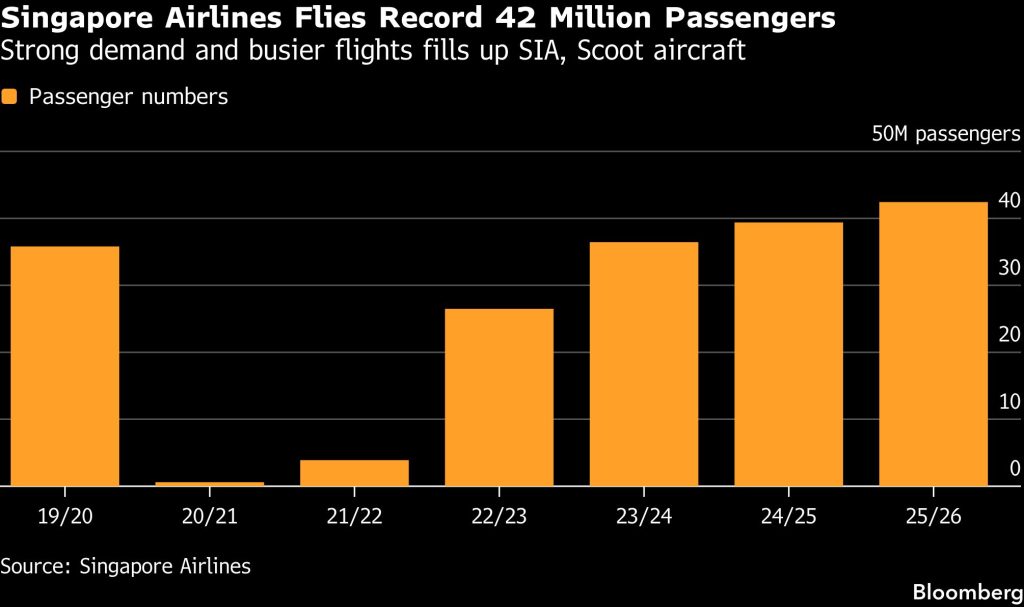
Although the carrier benefited from higher passenger volumes, thanks to travelers shifting routes to avoid Middle Eastern conflict zones, Singapore Air warned that the Iran war’s broader fallout could soon clip those gains. While surging fuel prices is the immediate impact of the war, it cautioned that it’s not the only cost.
“There could be broader implications for supply chains and macroeconomic conditions, affecting demand patterns,” Singapore Air said. In addition, it said airline operations for the industry risked disruption from the availability of jet fuel supply.
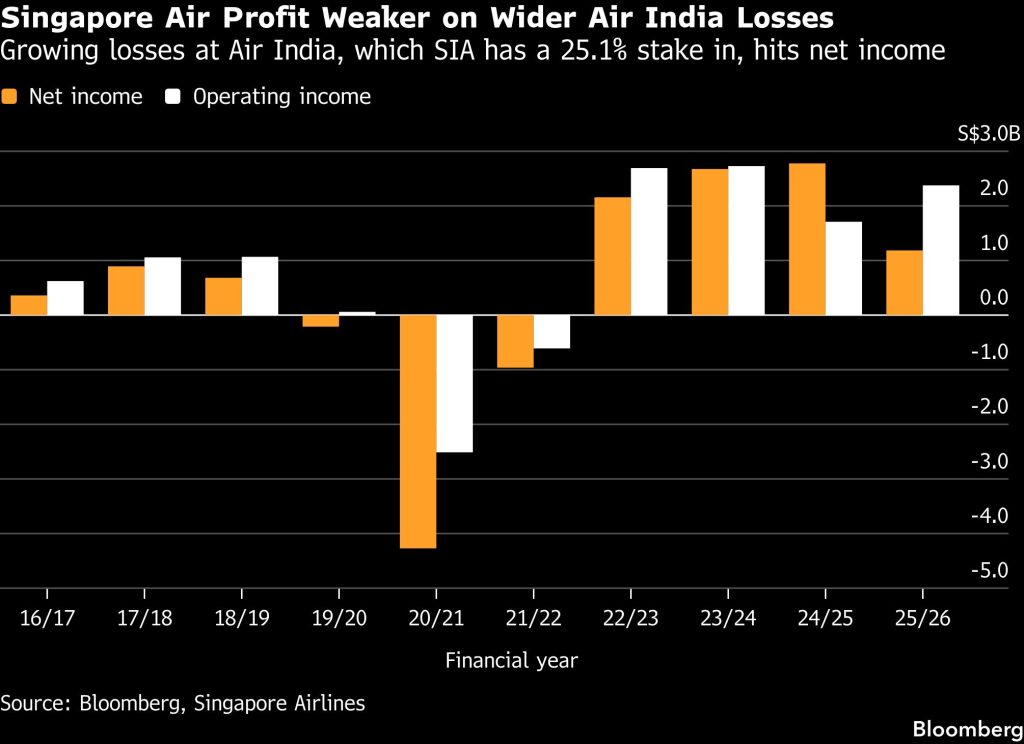
Singapore Air is tackling internal challenges too, with its in-tray busy with the turnaround of Air India. The Indian carrier’s record loss — driven by airspace closures, war-related disruptions and a fatal crash — has diluted SIA’s net income. Now controlled by Tata Group with the Singaporean carrier as a minority shareholder, Air India is burning through cash as it pursues a multi-billion dollar turnaround.
Singapore Air’s exposure may deepen. Both shareholders are in talks to inject more capital into Air India as losses mount, and they are searching for a new chief executive officer after Campbell Wilson said he would depart after nearly four years as CEO.
To keep the turnaround on track — including an order for over 500 new aircraft — Singapore Airlines has been placing more executives into key operational roles in the Indian carrier, Bloomberg has reported.
Air India is Singapore Air’s biggest financial investment in another airline, as it diversifies its reach. In recent years, the Singaporean airline has signed joint venture pacts with Malaysia Airlines, All Nippon Airways, Garuda Indonesia, Lufthansa Group and Air New Zealand, and is seeking a similar deal with Vietnam Airlines.
While the airline posted a sharp fall in net income, it trimmed its proposed total dividend for the year to 37 Singapore cents per share, including a final dividend of 22 cents in local currency.
Beyond its investment challenges, the airline is grappling with soaring jet fuel prices affecting airlines globally. The latest results reflect only one month of war-related impact, though the March demand remained strong: long-haul routes to Europe and the Americas were 94% full, while others averaged 88%.
On the direct Iran war impact, Singapore Air said the full effect of a more than doubling of jet fuel prices will be felt in the new fiscal year. Airfare hikes have not been enough to “fully offset” the rising cost of kerosene, the airline’s single-largest expense.
Singapore Airlines continues to shrug off the impact of high fuel costs by adding capacity to Europe, including to the UK and southern Europe. Low-cost unit Scoot is also contributing strongly to group performance, flying around a third of total passengers and expanding rapidly with new, smaller aircraft.
The airline’s shares closed 0.2% lower on Thursday, ahead of the results. The stock is down 2% so far this year. –BLOOMBERG
The post Singapore Air net profit drops as Iran war raises risks appeared first on The Malaysian Reserve.




 View original content to download multimedia:https://www.prnewswire.com/news-releases/allegheny-health-networks-cardiovascular-institute-sees-positive-outcomes-from-groundbreaking-therapy-for-treatment-resistant-hypertension-302771871.html

 View original content to download multimedia:https://www.prnewswire.com/news-releases/delta-beverages-contributes-to-national-advocacy-effort-supporting-hemp-beverage-regulation-302771333.html
 View original content to download multimedia:https://www.prnewswire.com/apac/news-releases/international-business-simulation-debuts-in-australia-four-teams-qualify-for-global-finals-in-shanghai-302772317.html

 View original content to download multimedia:https://www.prnewswire.com/news-releases/defi-technologies-appoints-russell-starr-as-strategic-advisor-302772092.html