


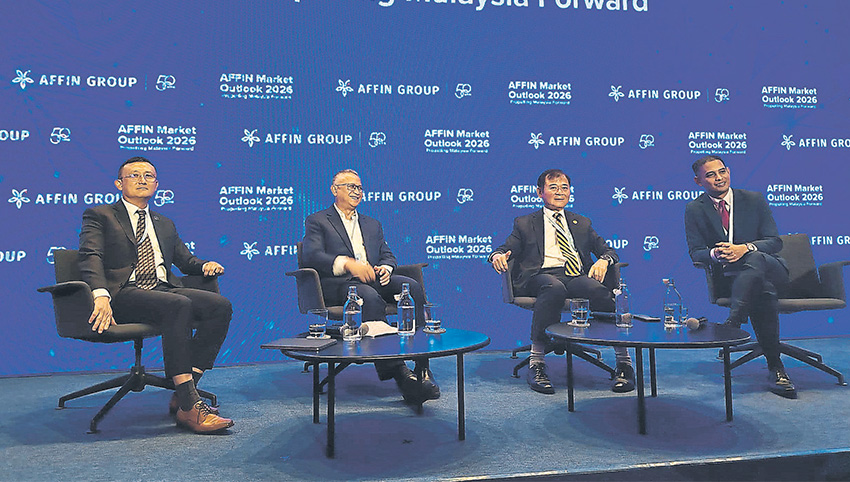
Both states have strong advantages including O&G reserves, abundant RE resources and growing digital economies
by SHAUQI WAHAB
SABAH and Sarawak are emerging as key drivers of Malaysia’s next phase of economic growth, powered by abundant natural resources, expanding digital infrastructure and rising investor interest in energ y and industrial development.
However, industry leaders said unlocking the full potential of both East Malaysian states will require stronger regional coordination, improved infrastructure, greater autonomy and sustained investment in human capital.
Speakers at Affin Bank Bhd’s Market Outlook 2026 forum in Kuala Lumpur last week said Sabah and Sarawak possess strategic advantages ranging from oil and gas (O&G) reserves to renewable energy (RE) resources and growing digital economies, but several structural and logistical barriers still need to be addressed.
Qhazanah Sabah Bhd CEO Damshal Awang Damit said Sabah is still in the early stages of unlocking its vast economic potential despite being richly endowed with oil, gas and mineral reserves, as well as RE resources such as solar, wind and geothermal power.
Sabah remains behind Sarawak in terms of development and resource monetisation, but said the state’s strategic location within the Brunei Darussalam-Indonesia-Malaysia-Philippines East ASEAN Growth Area (BIMP-EAGA) provides substantial opportunities for trade and investment.
Sabah also has potential to develop aerospace and satellite-launching activities because of its equatorial position, he added.
Established in 1994, BIMP-EAGA was created to accelerate development in remote and less-developed areas across Brunei, Indonesia, Malaysia and the Philippines. The economic sub-region includes Sabah, Sarawak and Labuan in Malaysia; along with Kalimantan, Sulawesi, Maluku and Papua in Indonesia; Mindanao and Palawan in the Philippines; and Brunei.
According to information published on the regional grouping’s website, the BIMP-EAGA economy was valued at US$1.34 trillion (RM5.29 trillion) in purchasing power parity terms in 2024, accounting for 18% of the combined GDP of the four participating countries.
As of April 2026, the grouping’s rolling pipeline of priority infrastructure projects had expanded to 265 projects from 57 in 2017, with a combined value of US$174.6 billion aimed at improving regional connectivity and economic integration.
Damshal said Sabah has already established institutions such as the Energy Commission of Sabah (ECOS) to strengthen state autonomy in energy management, but coordination between governments, agencies, investors and financial institutions remains a key challenge.
“We have all the advantages, but it’s just how to unlock the potential,” he said during the forum.
Digital, Energy Transformation
On digitalisation and energy transformation, Sarawak Energy Bhd (SEB) senior VP for strategy and corporate development Dr Chen Shiun said Sarawak’s energy sector has rapidly adopted advanced digital technologies to improve operations and customer engagement.
He said hydropower plants can now be remotely operated from Kuching through upgraded digital systems, while consumers are increasingly using digital applications to monitor and manage electricity consumption.
“Digitalisation is certainly one of the major pillars,” Chen said during the session titled Sarawak and Sabah: Malaysia’s Upcoming Economic Powerhouse.
Meanwhile, Sarawak Chamber of Commerce & Industry (SCCI) president Datuk Philip Ting highlighted Sarawak’s progress under the Sarawak Digital Economy Blueprint 2030.
Under the plan, the state aims to achieve 96% high-speed Internet coverage by 2030, establish five data centres, complete thousands of telecommunications towers and 5G sites, and fully digitalise government services.
The initiatives are intended to support long-term economic transformation and improve connectivity across the state, particularly in rural areas.
Separately, a recent research report by Kenanga Investment Bank Bhd (Kenanga Research) also pointed to several major development initiatives underway in Sarawak.
The report highlighted a proposed deep-sea port project, noting that its long-term viability would depend heavily on Petroleum Sarawak Bhd’s upstream and gas commercialisation plans, as well as the successful execution of the Kuching Low-Carbon Gas Hub to drive throughput demand.
Kenanga Research also noted plans for a new Kuching airport, which could improve airspace flexibility as the current airport’s operations are constrained by its proximity to West Kalimantan, Indonesia.
In addition, the report said Sarawak is intensifying efforts to develop its semiconductor industry through existing investments such as X-Fab Silicon Foundries and potential new initiatives focused on gallium nitride transistors and chip design, particularly for the automotive sector.
The research house added that water coverage improvement projects remain ongoing throughout the state, supported by increased budget allocations following the consolidation of the water regulator in August 2025.
Major Obstacles
Despite the strong growth prospects, panellists at the forum agreed that human capital remains one of the biggest obstacles facing both states.
Chen said better education, skills development and social mobility are needed to ensure rural and lower-income communities can participate meaningfully in the evolving economy.
“The soft skill is really something that we really need to bring up to the next level,” he said.
Damshal argued that coordination among stakeholders remains the primary challenge, particularly among governments, government-linked companies and financial institutions.
He called for stronger cooperation between Sabah, Sarawak, Brunei and the wider BIMP-EAGA region to formulate more effective development strategies.
“We need more effective coordination, rather than bottom-up approaches,” he said.
Ting identified human resources and logistics as Sarawak’s two biggest challenges, noting that the state requires hundreds of thousands of skilled workers while also facing transport and accessibility constraints because of its geography and low population density.
“Human resource is definitely one of the biggest challenges,” he said.
The discussion also touched on Sabah’s future energy mix. Damshal said the state currently has no coal-powered electricity generation but continues to face energy shortages and reserve limitations.
While RE remains a priority, he suggested that cleaner coal technologies combined with biomass and carbon capture solutions could help address Sabah’s energy requirements more quickly.
Chen stressed that Sarawak and the federal government must continue working closely on energy security and resource management to ensure mutually beneficial outcomes for both the state and Malaysia as a whole.
On talent retention, Ting said many Sarawakians working abroad are emotionally inclined to return home, but employment opportunities and long-term career prospects remain the deciding factors.
He added that Sarawak has been actively organising outreach programmes globally to encourage professionals to return and contribute to the state’s development.
- This article first appeared in The Malaysian Reserve weekly print edition
The post Sabah, Sarawak advance digital, energy transformation appeared first on The Malaysian Reserve.





 View original content to download multimedia:https://www.prnewswire.com/news-releases/datashapes-ai-partners-with-l3harris-to-provide-ai-enabled-radios-that-can-sense-and-respond-to-drones-302775011.html


 View original content to download multimedia:https://www.prnewswire.com/news-releases/eyepromise-introduces-heyedrate-clinical-a-next-generation-artificial-tear-302775001.html
 View original content:https://www.prnewswire.com/news-releases/volvo-group-north-america-has-made-a-settlement-with-carb-302775002.html

 View original content to download multimedia:https://www.prnewswire.com/news-releases/inventhelp-inventor-develops-improved-umbrella-chk-5049-302767873.html
 View original content:https://www.prnewswire.com/news-releases/rowland-ai-appoints-albert-chan-as-president-and-chief-ai-officer-302774790.html