
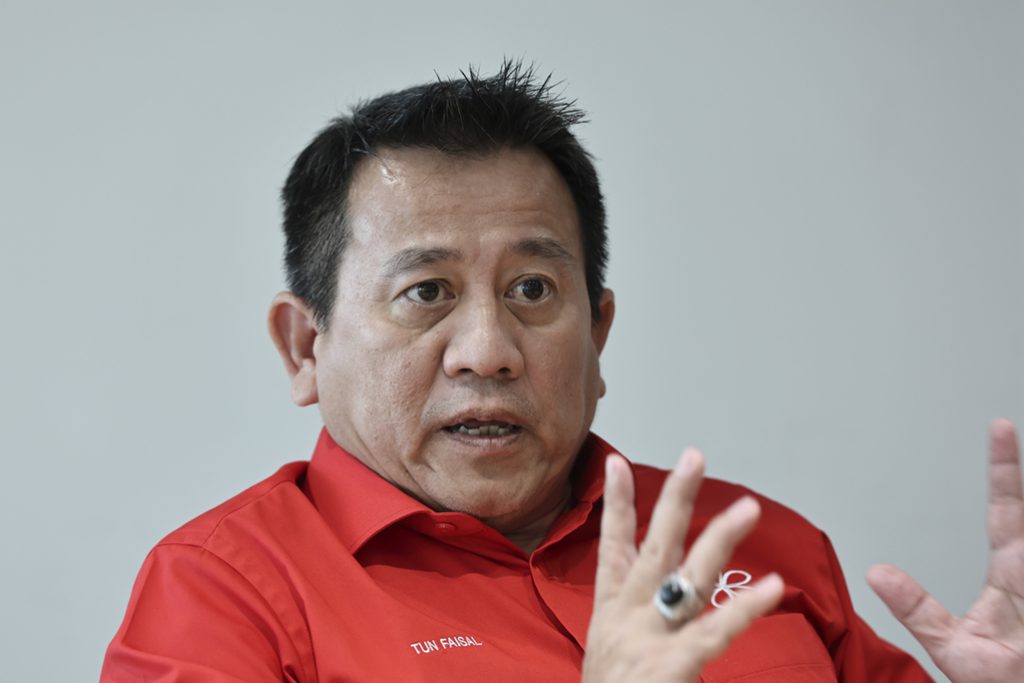
BERSATU information chief Tun Faisal Ismail Aziz’s (picture) call for deputy president Hamzah Zainudin to resign has triggered internal pushback within the party, even as it underscored deeper leadership tensions unfolding within Perikatan Nasional (PN), Free Malaysia Today (FMT) reported.
Tangga Batu Bersatu chief Ramlan Meon questioned whether Tun Faisal’s remarks reflected the position of party president Tan Sri Muhyiddin Yassin, saying the comments were not cleared by the party’s Supreme Council and risked misrepresenting Bersatu’s official stance.
“Since when can an information chief openly attack a party leader?” Ramlan asked. “Tun Faisal should be brought before the disciplinary board for publicly criticising the deputy president.”
Ramlan also said Tun Faisal’s actions had damaged the party’s image and reflected poorly on Muhyiddin, who had appointed him as information chief.
Tun Faisal had earlier rejected calls by Bersatu Supreme Council member Yunus Nurdin for Muhyiddin to step down as president, arguing instead that Hamzah should resign. He said Hamzah had failed to perform as the party’s Sabah election director, pointing out that Bersatu did not win a single seat in the state election last November.
In addition, Tun Faisal also accused Hamzah, who is the opposition leader, of failing to rein in his supporters, leading to repeated breaches of party discipline and the Bersatu constitution. He further defended Muhyiddin against claims that he had mishandled talks with PAS over the PN chairmanship, saying negotiations were still at the proposal stage and had yet to be finalised.
When asked to comment on Ramlan’s criticism, Tun Faisal urged party members not to practise “double standards”.
“Party members can repeatedly demand that the president step down after election failures,” he told FMT. “Yet, they get upset when it is suggested that the deputy president should step down due to his own failures and inability to control supporters who repeatedly violate party rules.”
The dispute comes as PN grapples with leadership uncertainty following Muhyiddin’s decision to step down as coalition chairman on Jan 1, with PAS subsequently laying claim to the post. Muhyiddin has proposed abolishing the chairmanship altogether and shifting executive authority to the PN presidential council, a move PAS has denied discussing.
Amid the leadership debate, Universiti Sains Malaysia’s (USM) Azmil Tayeb said opposition by PN components Gerakan and the Malaysian Indian People’s Party (MIPP) to PAS leading the coalition due to its “hardline” image made them no different from DAP.
“The tactic of spooking non-Malay voters over PAS makes these parties no different from DAP, which uses the same ploy,” he told FMT, adding that PN’s electoral machinery would still rely heavily on PAS’s grassroots strength.
However, Azmi Hassan of Akademi Nusantara said keeping Muhyiddin, or another Bersatu figure, at the top of PN would not significantly improve Gerakan’s or MIPP’s prospects, warning that the two non-Malay parties have struggled to attract voters regardless of PN’s leadership configuration.
Analysts have also cautioned that a proposed political “ceasefire” between Bersatu and PAS would remain fragile unless both parties resolve deeper ideological and governance disputes.
Meanwhile, Rabi’ah Aminudin of the International Islamic University of Malaysia (IIUM) said PAS and Bersatu differ fundamentally in their political orientation, with PAS prioritising long-term ideological goals while Bersatu focuses on immediate electoral survival.
“If they can reconcile these differences, they may have a stronger alliance for the next election, but I foresee things will remain transactional and fragile for now,” she said.
Azmi Hassan added that unresolved disputes in Perlis, including tensions involving the state government led by Bersatu’s Abu Bakar Hamzah, remain a critical pain point that could undermine broader cooperation within PN if left unaddressed.
The post Tun Faisal’s call for Hamzah to resign draws internal backlash in Bersatu appeared first on The Malaysian Reserve.




 View original content to download multimedia:https://www.prnewswire.com/news-releases/faraday-future-launches-three-series-of-robot-products-in-las-vegas-at-the-annual-nada-show-aiming-to-become-the-first-us-company-to-deliver-both-humanoid-and-bionic-robots-302679711.html