

Auto Added by WPeMatico
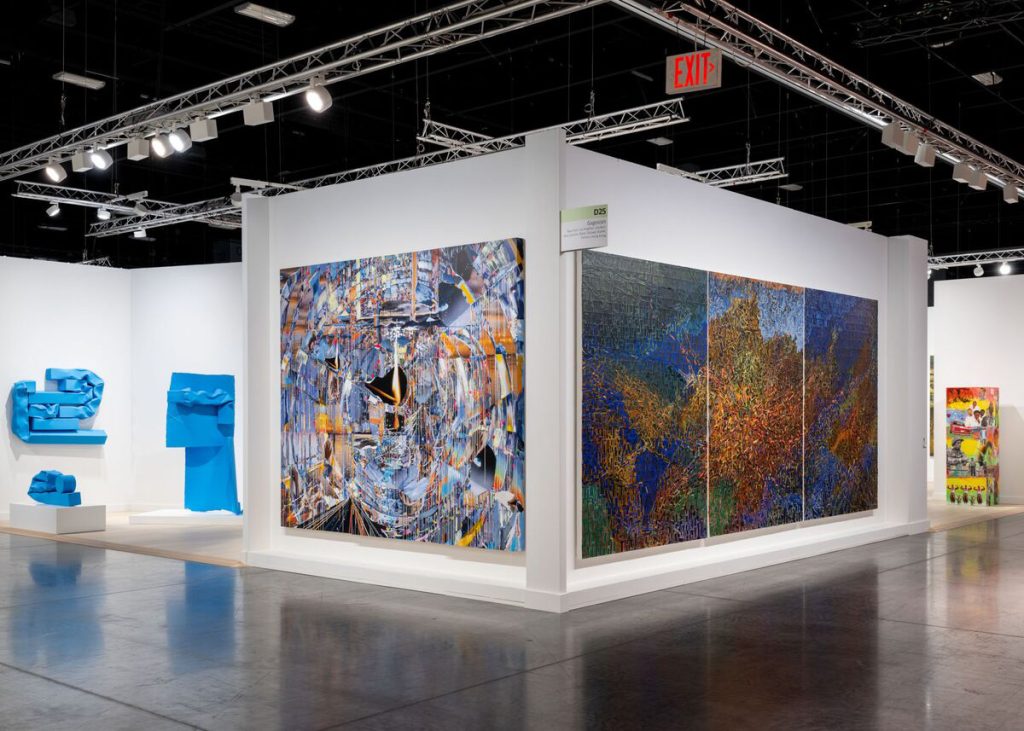

The reigning aesthetic is a type of quiet luxury: Subtle but recognisable, often abstract, maybe a little spiritual
by JULIA HALPERIN
AT ART Basel Miami Beach last December, I ran into an art dealer who was at her wits’ end. She described a mounting sense of déjà vu every time she entered a collector’s home. There it was again: A painting plastered in richly coloured, looping scrawl by Rashid Johnson. A mangled steel tube sculpture in a chewing-gum hue by Carol Bove. An uncanny pastel landscape by Nicolas Party.
“Why,” she asked, “does everyone’s art collection look the same right now?”
Signalling Something
She isn’t the only one wondering. The Belgian art collector Alain Servais said he’s had similar experiences in Istanbul, Mumbai, Dubai, New York and Paris. He couldn’t go anywhere without coming face-to-face with kaleidoscopic clusters of glass spheres by Olafur Eliasson. It’s “one name I cannot see anymore”, he said.
Art collecting has always been, to some degree, an exercise in signalling something: Power, wealth, education, taste. Effective signalling requires consensus around what kind of art is desirable. But some market observers said this moment offers a distinct sense of sameness.
There are a variety of reasons for this phenomenon. While art collecting used to be a private endeavour, it’s easier than ever to know what tastemakers are buying because they post their purchases on Instagram and pose for home tours in design publications. Plus, the proliferation of art fairs has placed pressure on artists to produce more and more work, especially from series that are already commercially successful.
The skyrocketing price of art means that collectors are also less likely to buy something they believe has no chance of appreciating in value. (After a certain price point, art for art’s sake can no longer hold.)
The art advisor Alex Glauber notes that he was able to find “a number of interesting things” at Art Basel in Switzerland 20 years ago for less than US$10,000 (RM39,100). Now, “the entry-level price point could be double that, at least.” (The price of art has risen along with the cost of doing business for art dealers, whose operating budgets rose 10%, on average, from 2023 to 2024, according to the 2025 Art Basel and UBS Art Market Report.)
Without a dominant style to flock to — like pop art in the 1960s or minimalism in the 1970s — buyers are more inclined to take cues from their peers or established dealer-brands. “Few collectors have confidence in their own taste,” Glauber said.
“It’s not a new problem,” said art historian Véronique Chagnon-Burke, co-chair of the International Art Market Studies Association. This kind of hive mind seems to appear during moments of heightened wealth inequality, like in the late 19th-century Gilded Age, the 1980s and the years leading up to the 2008 global financial crisis, said Sotheby’s Institute of Art dean Natasha Degen.
In a market fuelled by wealth disparity and a winner-take-all dynamic (56% of a gallery’s sales come from just three of its artists on average, according to the 2025 UBS Art Basel report), certain names become “ever more powerful signifiers,” she noted. Today, as in the past, many people entering the market “acquire art for social recognition, the same way they drink the 80-year-old bourbon and drive the same Aston Martin or Tesla truck,” Servais said.
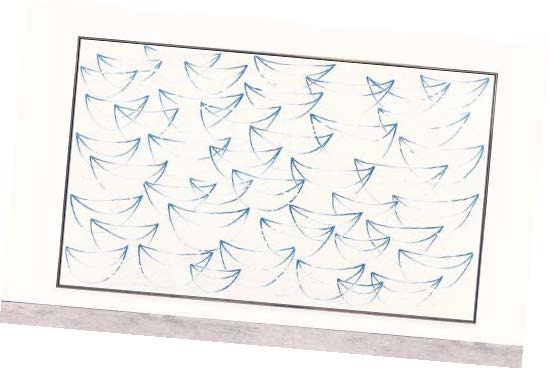
Johnson’s Seascape ‘The Beaches’ (2023). Rising art prices make collectors less likely to buy pieces unlikely to increase in value (Source: Hauser & Wirth)
Quiet Luxury
More notable than the consensus, perhaps, is the type of art today’s cosmopolitan elite is rallying around. It isn’t contemporary portraiture, which was all the rage just a few years ago. It isn’t art explicitly engaged with the digital age, politics or media. It has vanishingly few references to street or pop culture. You won’t see much KAWS — the wildly popular creator some consider the art equivalent of a Cybertruck — in the living rooms of Palm Beach.
Instead, the reigning aesthetic, at least among a certain set, is a type of quiet luxury: Subtle but recognisable, often abstract and maybe just a little bit psychedelic or spiritual. One strand of popular painting, exemplified by artists Lauren Quin and Lucy Bull, is an exuberant, richly layered abstraction that looks like the product of an acid trip or lucid dream.
Other favourites, according to collectors and advisors, are iridescent-panelled modules by Tomás Saraceno and abstract photographs by Wolfgang Tillmans, which the German artist creates by manipulating light and chemicals on photosensitive paper.
The art du jour has a “politically neutral quality and brand-name recognisability,” said Degen. “With that comes the knowledge of the price point and the access…‘Oh, you were able to get a Tillmans, good for you.’” Tillmans, like some of his quiet-luxury peers, has made plenty of political work, from anti-Brexit posters to documentation of his HIV treatment. But that’s not what the market is chasing. Abstractions make up Tillmans’ top 48 auction results, according to the Artnet Price Database.
Part of the appeal of quiet-luxury art is escapism, posited New York’s Franklin Parrasch Gallery partner Suzi Parrasch. “We went through a period of so much representational art,” she said, referring to the vogue for portraiture and other figurative painting that defined the booming market from 2020-2022.
During that period, art fair walls were full of work by women and artists of colour that engaged with their personal histories. Now, as the political pendulum swings wildly, collectors are expressing a “desire to meditate on their walls because everyone is so tense outside. They need to see something else when they come inside”.
Having much of today’s most fashionable art sold by a small handful of dealers only adds to collecting uniformity. Johnson’s anxiety-riddled paintings may look quite different from Party’s objectively pretty pastels, but both men are represented by the behemoth Swiss dealership Hauser & Wirth. Tillmans and Bove are represented by David Zwirner, which has earned a reputation as the mega-gallery for the European sophisticate. Eliasson and Saraceno work with a smaller New York dealer, Tanya Bonakdar.
Pre-vetted Bets
What makes this moment different from the past — when robber barons converged on Valentine Gallery in New York, for example, or when early-2000s hedge funders elbowed their way into Gagosian — is that the gallery has, in some cases, become a more prominent brand than the artists it represents. As megagallery rosters swell to 80 or 90 artists at various career stages, it’s unlikely most collectors will be familiar with them all, Degen said — but the assumption becomes they’re pre-vetted bets.
The art advisor and former Christie’s specialist Saara Pritchard recalled a former client who was “Zwirner-obsessed…I would send them every Zwirner artist we got. Unless you knew they were Zwirner artists, you wouldn’t think to send them to the same person. But it worked every time.” Several advisors independently mentioned the story of a collector giving a tour of the artworks on his walls by identifying the galleries from which he bought them rather than the artists who made them.
Advisors can help collectors gain access to these sought-after galleries, which tend to favour existing relationships over novice buyers. But if the advisor offers similar work to all their clients, their involvement can compound the sameness problem. “The advisor comes back to the same well because they have access there,” said the art advisor Todd Levin.
Consensus can offer a false sense of security to collectors, experts warn. Some of the artists most in vogue today have long careers behind them, support from taste-making curators and high-profile museum exhibitions under their belt. But many have more buzz than they do indicators of career longevity or history-changing work. Their success may be the result, as several experts have put it, of collectors buying with their ears rather than their eyes.
Chagnon-Burke noted that some of the most popular art of the Gilded Age was 19th-century French academic painting — until it was swiftly overshadowed by modern artists like Henri Matisse and Pablo Picasso and relegated to the margins of both art history and the market. “When there is such a strong consensus and it coincides with a flurry in market activity, there is a danger,” Degen said, that “when the moment passes, it will seem dated.” — Bloomberg
- This article first appeared in The Malaysian Reserve weekly print edition
The post Why does everyone’s art collection look the same? appeared first on The Malaysian Reserve.