
Auto Added by WPeMatico

EcoSave Savings Account-i aims to make conservation funding feel like repeatable mechanism that grows with participation in everyday banking
by AKMAR ANNUAR
CIMB Islamic Bank Bhd is allocating RM20 million for environment conservation from 2026 to 2030.
CEO Ahmad Shahriman Mohd Shariff said the five-year pledge builds on a conservation journey that has expanded from a flagship urban park in Kuala Lumpur (KL) into a wider portfolio spanning forests, watersheds, islands and education sites in eight states.
Ahmad Shahriman also shared that the EcoSave Savings Account-i is designed to make conservation funding feel less like a one-off donation drive and more like a repeatable mechanism that grows with public participation in everyday banking.
The account is based on the Islamic concept of “Tawarruq”. Out of the total EcoSave portfolio, CIMB Islamic contributes 0.2% to green activities, such as conservation initiatives and education programmes that help protect the environment and sustain its natural resources for current and future generations.
“CIMB Islamic will channel the contribution from its own funds, positioning the product as a structured fundraising stream that can be tracked and expanded alongside programme delivery,” Ahmad Shahriman said.
Customers can open EcoSave-i digitally via the CIMB OCTO app or at any CIMB branch, with the bank offering a RM5 cash incentive for customers who maintain a RM5,000 minimum monthly average balance and do not perform over-the-counter transactions in a month.

Ahmad Uzeir believes that young people are active voices who can push accountability and shift norms
Scaling Up Community Activation
The Green Showcase was anchored by a morning agenda that began with guest arrivals at Taman Tugu Nursery, followed by briefings and a nature walk before the tree-planting segment closed the programme.
The programme also renewed CIMB Islamic’s agreement with Amanah Warisan Negara (Awan), the primary custodian of Taman Tugu, to continue the Taman Tugu Adoption and Nature Education Programme for another two years.
In the background, the bank framed the refreshed pledge as a move to scale up community activation, after learning that legal protection and research-heavy approaches can stall when processes move slowly or when priorities shift.
Ahmad Shahriman said conservation gains last longer when communities adopt a site as their own, because ownership keeps stewardship alive even when administrations or corporate leadership changes.
The bank’s expanded partner roster for the renewed pledge includes Awan, The Habitat Foundation, Reef Check Malaysia, Universiti Pendidikan Sultan Idris (UPSI), Malaysia Nature Society, World Wide Fund for Nature, Malaysia (WWF-Malaysia), Malaysia Forest Fund, Forest House, Leap Spiral, Your Idea Maker, Free Tree Society and Penang Institute.
While the RM20 million commitment sets the umbrella, the partner sessions were meant to show how that envelope breaks down into distinct ecosystems and priorities, from urban green corridors to northern water catchments and Sabah’s watershed protection work.
Ahmad Shahriman said the goal is for the public to see outcomes not only in protected hectares or the number of planted trees, but also in how conservation becomes a lived culture, shaped through education, repeat visits and community-led programmes.
He recalled how CIMB Islamic’s Taman Tugu sponsorship began during the Covid-19 period and later evolved into a broader nature education platform once public access normalised.
He added that conservation, like banking, can only be sustained when it is designed to outlast short cycles and remain relevant to how people actually live.
The bank also positioned the initiative within CIMB Group’s wider sustainability financing ambition, where the group has set a target to enable RM300 billion in sustainable financing by 2030 under its sustainability framework.

If you come to Sabah, please support the ecotourism business in Kampung Tampasak, says Gondungan (Pics courtesy of CIMB Group)
Pocket Talks
Beyond the mechanics, the pocket talks were the day’s centrepiece, functioning like “field notes” from each conservation partner on what needs protecting, what is at stake, and what kind of behaviour change is required for the work to hold.
The first talk in the session list was delivered by project leader Elycia Gondungan, who spoke on “Protecting Babagon: How Sabah’s Water Catchment Sustains Communities and Nature”.
Gondungan shared how the Babagon water catchment links directly to household realities, where watershed health is inseparable from daily water security and community livelihoods.
“If you ever come to Sabah, please come to Kampung Tampasak (in Penampang District, near Babagon) and support the ecotourism business there, and also you can support us by advocating for the formal adoption of payment for ecosystem services in Sabah,” she said.
Her point, delivered simply, was that protection is not only about forest boundaries, but also about making conservation financially and socially workable for communities living close to critical ecosystem assets.

Hon’s message is nature functions like infrastructure and degradation creates downstream ripple effects
From WWF-Malaysia, conservation (Sarawak) head Dr Jason Hon focused on “Ulu Muda Forest Complex Conservation”, centring on Ulu Muda’s role as an ecosystem that quietly supports economic fundamentals in the north, particularly agriculture and water supply systems that Malaysians often take for granted.
“Ulu Muda is teeming with wildlife. You can see a lot of elephants, tigers, as well as the kind of the water supply that helps sustain both humans as well as helping to grow rice for our nation,” he said.
The message was not that nature is “nice to have”, but that it functions like infrastructure, where degradation creates downstream costs that ripple into food systems and communities.
The third pocket talk was delivered by The Habitat Foundation, with community engagement team lead Ahmad Uzeir Ahmad Murshid focusing on “Youth and Environmental Advocacy”.
The session placed young people at the centre of conservation momentum, not as passive recipients of environmental education, but as active voices who can push accountability, shift norms and build long-term public ownership of nature protection.
“So, our mission actually is to conserve, educate and inspire,” he said.
Ahmad Uzeir’s framing matched the broader theme of the day, where conservation is treated as a culture-building project, sustained by repeated community engagement rather than one-time campaigns.
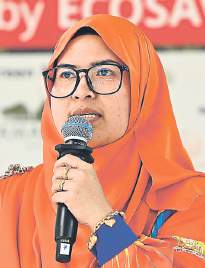
Azi Azeyanty emphasises the idea of forests as habitats that can teach conservation skills through fieldwork
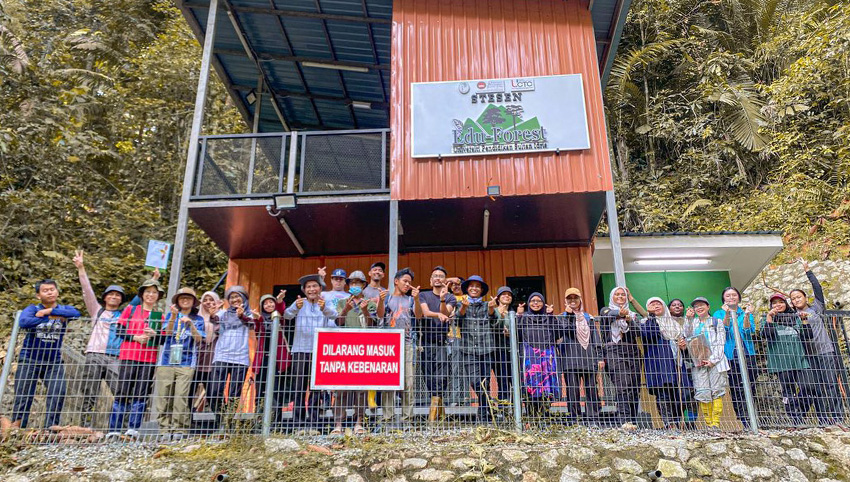
The fourth talk was delivered by UPSI senior lecturer Dr Azi Azeyanty Jamaludin who focused on “Sustain- able Conservation Practices towards Edu-forest”.
The session emphasised the idea of “living ecosystems” as education sites, where forests are not treated as decorative green spaces but as functioning habitats that can teach conservation skills through fieldwork.
“UPSI Edu-forest is not an artificial, landscaped park — it is a real forest ecosystem within the Behrang Forest Reserve, a Permanent Forest Reserve,” she said.
The talk also outlined how conservation education can be structured through trails, signage and guided engagement, making access safer while helping visitors understand what they are seeing and why it matters.
Malaysia Nature Society (MNS) conservation head Donovan Louis then spoke on “Rehabilitate Green Spaces”, which leaned towards practical rehabilitation and often looks less glamorous than wildlife campaigns but is central to restoring ecological function in fragmented landscapes, especially in and around urban areas.
Louis shared that Greater KL’s remaining forest fragments need to be treated as connected corridors, not isolated patches, because fragmentation weakens biodiversity over time.
He explained that rehabilitation in an urban setting also requires proper access planning, maintenance and monitoring to protect sensitive ground cover while keeping trails safe for public use.
“It’s just not planting a tree, because you have to look after it and you need technical expertise,” he said.
Louis stressed that this is why sustained funding matters, as corridor-building and rehabilitation are multi-year efforts that require continuity rather than one-off interventions.

According to Louis, rehabilitation is multi- year efforts that requires continuity rather than one-off interventions
Direct Conversation
Across the broader portfolio, CIMB Islamic said its northern corridor work continues to include biodiversity efforts linked to the Penang Hill Biosphere Reserve and Royal Belum State Park, alongside forest restoration and human-elephant conflict mitigation in Ulu Muda, Kedah.
A key spine of the agenda is also the Central Forest Spine, including initiatives such as the UPSI Edu-forest programme, the Rantaian Urban Green Space project and the Penjaga Gunung project that empowers Orang Asli youth as the next generation of forest stewards.
In Terengganu, CIMB Islamic is deepening work in Setiu, while supporting coastal and coral rehabilitation in Redang, Tioman and the Mersing islands, linking ecosystem resilience with tourism and coastal community livelihoods.
In Sabah, the portfolio includes support for the Babagon Water Catchment and the Ulu Kalumpang Rehabilitation Programme, framed around watershed protection and wetland habitat restoration. Ahmad Shahriman said the bank’s conservation work has increasingly moved towards programmes that pull communities into the sites, because repeated engagement builds familiarity, and familiarity creates a sense of responsibility that cannot be legislated into existence.
He said this is where products like EcoSave-i matter, because funding needs to keep flowing even when public attention moves on and conservation partners need to plan in multi-year horizons rather than annual cycles.
The Green Showcase, by design, put partners in direct conversation with attendees, turning what could have been a single-day announcement into a wider narrative of place-based projects, each with different pressures, communities and solutions.
For CIMB Islamic, the challenge now is to keep the EcoSave-i mechanism understandable and visible to customers, while ensuring the RM20 million portfolio translates into outcomes that the public can recognise and feel connected to.
CIMB Group has been upgraded from AA to AAA, which is the highest rating, in the Morgan Stanley Capital International’s environmental, social and governance ratings (MSCI ESG Ratings).
- This article first appeared in The Malaysian Reserve weekly print edition
The post CIMB Islamic continues conservation journey with RM20m pledge appeared first on The Malaysian Reserve.