

Auto Added by WPeMatico


The programme is anchored by a talk show-style discussion that places trust and authenticity at its centre
by AKMAR ANNUAR
IF YOU arrived expecting a campaign rah-rah, you would have been pleasantly surprised.
Gongxi Raya, Kongsi Sukses had the lightness of a festive catch-up — a room dressed with just enough colour to signal Chinese New Year (CNY) and Aidilfitri, without tipping into theatre and a crowd that looked more curious than hurried.
There was a steady hum of conversation, creators greeting each other like colleagues who finally get to meet offline, and brand teams lingering to listen rather than rush back to a booth.
For a few hours, the mood was easy, almost breezy, but the message underneath it was serious: Online shopping only scales when people feel safe enough to keep coming back.
Lazada Malaysia CEO Kaya Qin described the gathering as a deliberate blend of seasons and communities, and she said the idea was to bring people together in a way that reflects how Malaysians actually shop now.
“Gongxi Raya, Kongsi Sukses is a creative way to bring CNY and Aidilfitri together,” she told The Malaysian Reserve (TMR).
The programme was anchored by a talk show-style discussion that placed trust and authenticity at the centre, rather than treating them as decorative values.
Lazada described the session as a conversation between four practitioners on how credibility is built in today’s digital landscape, balancing the brand lens with the creator lens, and returning to the same conclusion: Being seen matters, but being believed matters more.
Representing brands, Jean Perry Malaysia sales, marketing and operations head Jimmy Sun and Christy Ng Sdn Bhd founder and CEO Christy Ng spoke about what it takes to earn repeat customers over years, not weeks.
From the creator side, Lazada exclusive strategic content creator partners Vickie Siah and Stella Boo discussed how trust is won through consistent, responsible content that feels real to audiences.
Sun’s remarks felt especially grounded because his business sits in the everyday — bedding, towels, household items that people buy when they want comfort, not drama.
“For a homegrown brand like Jean Perry, trust is built over time through consistency, product quality, and delivering what customers expect every time they shop. Working with Lazada helps us strengthen that trust at scale because consumers can find our official store presence, compare product information clearly and shop with greater confidence through a platform they can trust,” he said in a sharing session.
What he described, in essence, was a shopping experience where customers do not have to second-guess.
A verified store presence matters because it signals legitimacy, clearer product details reduce uncertainty, and a trusted platform smooths the decision for shoppers who are already juggling hundreds of choices online.

According to Ng, ‘value’ shows up in workmanship, fit, durability and how quickly the brand responds when something goes wrong
Ng’s sharing session, on the other hand, carried the kind of narrative people lean into — not because it is glamorous, but because it is familiar: A brand beginning in a small space, then growing beyond what one person can hold alone.
“I started the business from my living room with just RM10,000 in capital,” Ng said.
She spoke about the moment a business stops feeling like a personal project and starts feeling like a responsibility — to staff, to customers, to the standards a brand becomes known for.
A big part of her story, she explained, is sticking to a promise of value and then protecting it through quality control and customer recovery, whether that means replacing items, offering refunds or providing store credit when something does not meet expectations.
Ng’s philosophy on value came through plainly, the kind of line that sounds almost too simple until you realise it takes discipline to deliver.
“When a customer pays RM100 for our item, they should feel like they got RM200 worth of value,” she said.
She explained that customers are sharper and more comparative now, so “value” is not a slogan — it shows up in workmanship, fit, durability and how quickly the brand responds when something goes wrong.
She also shared how the brand hires, particularly for content roles, with a short video submission used as an early filter to test basic execution before interviews and feedback-based assessments.
It was one of those details that made the room nod, because it matched what creators already know: The online world rewards consistency, but it also punishes sloppiness.
Siah and Boo’s part of the session picked up from there, reflecting on what audiences respond to and what turns them away.
They spoke about credibility as something built slowly — through clear disclosures, honest reviews, and content that prioritises usefulness over hype — while relatability matters because audiences can tell when a recommendation is forced.
The talk show’s strength was that it did not pretend trust is a single feature you can install.
It is a chain of small decisions: How a product is listed, how a seller is rated, how a complaint is handled, how a creator frames a recommendation, and how quickly the platform resolves friction.
Lazada positioned its 2026 push as a move towards tightening that chain, with LazMall framed as the “trusted mall” environment it wants consumers to feel every time they shop.
“2026 is about raising the standard of online shopping in Malaysia, and Lazada is not only focused on bigger campaign moments,” Qin said.
Lazada is focused on building LazMall into a destination of choice where trust, authenticity and confidence come through in every purchase, working with creators, brand partners and sellers to help consumers shop smarter each day.
When asked what that standard looks like beyond campaign language, Qin kept it straightforward.
“We focus on quality — trust, authenticity, and the full end-to-end experience,” she shared with TMR.
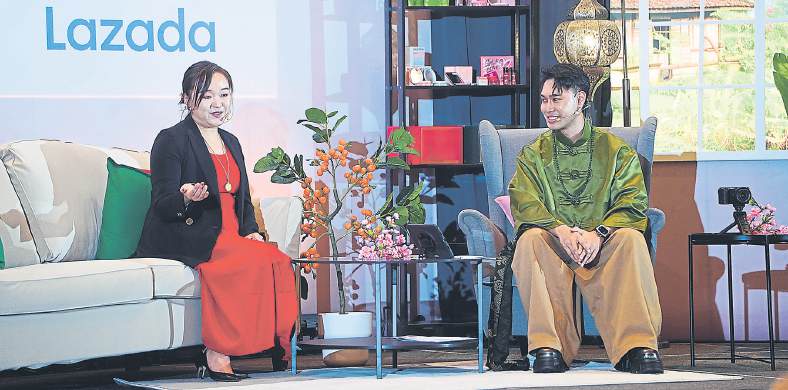
Qin (left) says Lazada is focused on building LazMall into a destination of choice where trust, authenticity and confidence come through in every purchase
That end-to-end framing has become more relevant as Malaysian shopping habits blend physical and online behaviour.
Many people still want to see something in person — touch fabric, check sizing, compare colours — but they also want the convenience of ordering online when the conditions feel safe.
Qin informed TMR that Lazada’s own reading of the market is supported by Cube Asia’s 2025 regional study, The Rise of Virtual Mall Ecosystems in South-East Asia, which points to how comfortable Malaysians are with buying inside trusted online “mall” environments.
The Malaysia findings showed that all 1,000 shoppers surveyed had made a purchase from LazMall, while a growing share now uses it for the majority of their purchases.
“What is even more powerful is how much they are leaning into it. 28% are now doing more than 80% of their total purchases via LazMall, another 32% are doing 60% to 80%, and 24.6% rely on LazMall for 40% to 60% of their purchases,” she explained.
That figure fits neatly with the mood in the room.
The distribution suggests this is no longer a niche habit, with a sizeable segment relying on LazMall for most shopping, rather than using it only for occasional big-ticket buys.
Qin said the pattern reflects a simple expectation: Malaysians want to know they are buying from the right source, they want what arrives to match what they saw online, and they want reassurance if something goes wrong.
The same Cube data also captured how common “show-rooming” is, with 91.3% reporting that they visited a physical store to view or try an item, then purchased it online.
People are not abandoning malls so much as extending the mall mindset into digital spaces — looking for verification, comfort and a sense that someone will be accountable if the experience falls short.
When the session wrapped, the atmosphere stayed light.
People lingered, chatted, laughed and moved around the space without the usual “event-ending rush”, as if the room had briefly become its own little community.
And perhaps that was the point of Gongxi Raya, Kongsi Sukses.
It was festive, yes, but it was also a quiet argument for why shopping confidence is built the same way relationships are: Through consistency, small proofs and the feeling that you are not being taken for a ride.
- This article first appeared in The Malaysian Reserve weekly print edition
The post Trust in the cart with Lazada’s Gongxi Raya, Kongsi Sukses appeared first on The Malaysian Reserve.